July 15, 2024
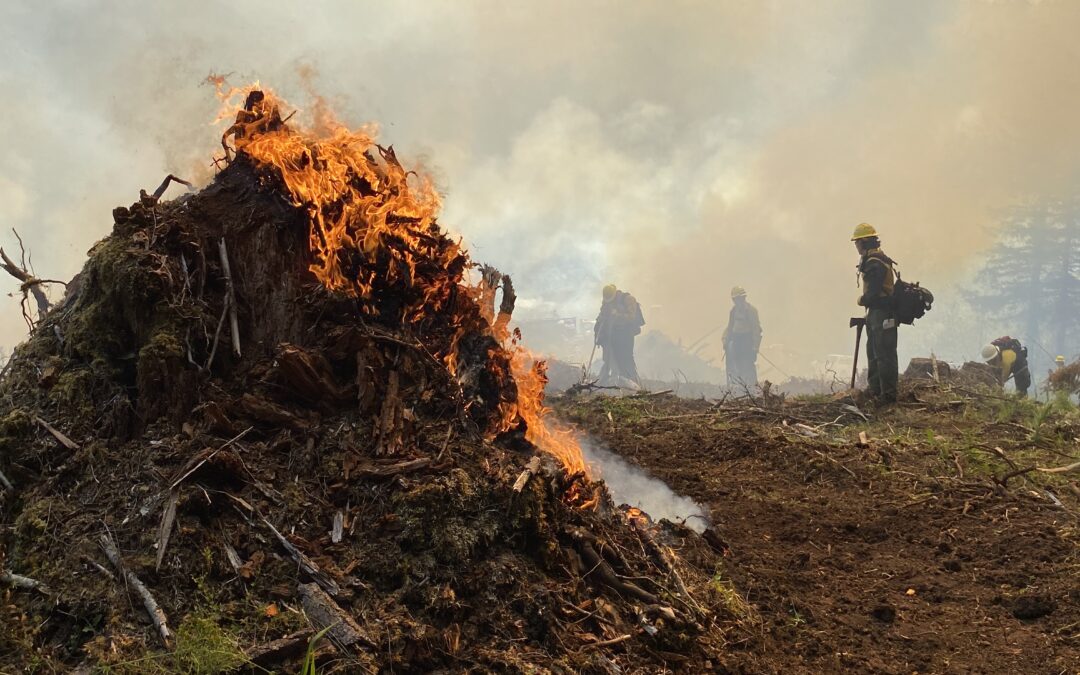
SALEM, Ore. – The Oregon State Fire Marshal and the Oregon Department of Forestry are bringing in out-of-state firefighters and equipment to fight several wildfires impacting communities and resources across the state.
On Sunday night, the Oregon State Fire Marshal mobilized two task forces from Washington to add structural firefighter capacity. The two task forces are from Snohomish, Thurston, and Grays Harbor counties with 29 firefighters, eight engines, and two water tenders. The task forces are assigned to the Falls Fire in Harney County.
“We are bringing in additional support from the Washington fire service for the Falls Fire, the severe drawdown of Oregon resources, and the anticipated weather conditions,” Oregon State Fire Marshal Mariana Ruiz-Temple said. “Our strong relationship with the Washington fire service is invaluable, especially during their responses to Oregon in 2017 and 2020. We have a robust response system that transcends borders and supports our mutual missions. I can’t thank the Washington fire service enough for their quick and reliable response to Oregon’s needs.”
The OSFM works with the Oregon Department of Emergency Management to mobilize these resources through the Emergency Management Assistance Compact, a national interstate mutual aid agreement that allows states to share resources during times of disaster.
The Oregon Department of Forestry (ODF) has received more than 58 resources from New Mexico, Idaho, Montana, Oklahoma, Texas, Georgia, Colorado, and Florida to assist in the Salt Creek and Larch Creek Fire. The agency will receive 13 more firefighters from Florida in the coming days to assist the agency’s Incident Management Team 3 and other severity efforts.
A total of 71 resources are coming to Oregon through state-to-state mutual aid agreements and the Northwest Compact. The compact was created to facilitate assistance in wildland fire pre-suppression and suppression efforts between member agencies, which include Hawaii, Alaska, Washington, Oregon, Idaho and Montana and the Canadian provinces of Alberta, British Columbia, Saskatchewan, and the Yukon and Northwest Territories.
“These mutual aid agreements help to bolster the complete and coordinated fire system in Oregon by giving us the ability to scale up as needed during peak times in the season” said Chris Cline, ODF protection division chief. “We appreciate our partners for sending us these much-needed resources as we manage several fires across the state.”
By creating a cache of reciprocal resources through mutual aid agreements, Oregon and other agencies can benefit from each other when fire seasons hit hard and resources become strained.
“This isn’t my first time to Oregon. It is always an honor to help our neighbors when they are in need. Oregon has come to help us several times in the past,” Task Force Leader Travis Hots said. “We are no stranger to how Oregon does business and are always impressed with how the Oregon State Fire Marshal treats its firefighters, so we are always glad to come down and offer a helping hand.”
On Friday, the Governor Tina Kotek issued a State of Emergency that allows the two agencies to request additional help from both in- and out-of-state partners.
With hot, dry, and windy conditions coupled with lightning in the forecast, Oregonians should take every precaution to avoid sparking a fire. Learn how to be #WildfireAware here. Look up your local fire restrictions at https://www.oregon.gov/odf/fire/pages/restrictions.aspx.
July 9, 2024
NORTHWEST, Ore. — Due to the extreme high temperatures throughout the region, the fire managers will be increasing the fire danger level to High (yellow) for recreationists using the forests in the NW-2 and NW-3 weather zones. This change will be effective at 12:01 a.m. on Wednesday, July 10, 2024.
All OHV trails in the Nicolai Mountain OHV Riding Area will close at 1 p.m. daily during High (yellow) Fire Danger level. Additionally, all campfires and barbeques are prohibited in the dispersed campsites in the Nicolai OHV Area (Shingle Mill, Viewpoint, Kerry, Plympton) and Lost Lake.
In NW-2 and NW-3 under the fire danger level High (yellow): Campfires are only allowed in designated metal fire pits at the following locations: Henry Rierson Spruce Run Campground, Gnat Creek Campground, Northrup Creek Horse Camp and Beaver Eddy sites in Clatsop County. For other campgrounds, check with the corresponding ODF office.
Burn barrels and residential campfires are not allowed in NW-2 and NW-3 under High (yellow).
For industrial forest operations: NW-1 will remain at Level I and NW-2 and NW-3 will move to Level II, with most operations shutting down at 1 p.m.
Fireworks, exploding targets/tracer ammunition, sky lanterns are prohibited at all levels during fire season.
For up-to-date recorded information about fire season requirements, call 503-325-7215. To request a burning permit or obtain additional information, call 503-325-5451 during business hours.
Public Restrictions Website: https://www.oregon.gov/odf/fire/pages/restrictions.aspx
July 8, 2024
LA GRANDE, Ore. — The fire danger level on lands protected by the Oregon Department of Forestry in Northeast Oregon will increase to “high” (yellow) on Monday, July 8, 2024, at 12:01 a.m. This change affects private, state, county, municipal, and tribal lands in seven counties: Union, Baker, Wallowa, Umatilla, and small portions of Malheur, Grant, and Morrow Counties. This area encompasses approximately 2 million acres of protected lands.
The increased fire restrictions are meant to prevent or minimize human-caused wildfires and to safeguard natural resources, public health, and safety. “Normal summer weather is forecasted for the foreseeable future, with high temperatures. These conditions, along with the rising fire danger, have led us to implement additional fire restrictions,” said Matt Hoehna, Assistant District Forester.
The Public Use Restrictions (High Fire Danger) include the following fire prevention measures:
- Open fires are prohibited, including campfires, charcoal fires, cooking fires, and warming fires, except at designated locations.
-
- Portable cooking stoves using liquefied or bottled fuels are allowed.
-
- Propane fire pits are allowed if they are self-contained and 3 feet away from any flammable fuels with a maximum flame height of 2 feet.
- Non-industrial Chainsaw use is prohibited from noon to 8 p.m.
-
- Non-industrial chainsaw use is allowed at all other hours if the following firefighting equipment is present with each operating saw: one shovel or other firefighting tool and one 8-ounce or larger fire extinguisher or 1-gallon of water. In addition, a fire watch is required at least one hour following the end of chainsaw use.
-
- Electric Chainsaws are allowed all day.
- Cutting, grinding, and welding of metal is prohibited from Noon-8 p.m. Cutting, grinding, and welding of metal is permitted at all other hours, if conducted in a 10-foot area cleared of flammable vegetation, shovel or other firefighting tool, a minimum of 1-gallon of water, or 2 ½ pound or larger fire extinguisher.
- Mowing dried and cured grass with power-driven equipment is prohibited from noon to 8 p.m., except for the commercial culture and harvest of agricultural crops.
-
- Electric string trimmers are allowed all day.
- Any electric fence controller in use shall be: 1) Listed by a nationally recognized testing laboratory or certified by the Department of Consumer and Business Services; and 2) Operated in compliance with the manufacturer’s instructions.
- Possession of the following firefighting equipment is required for any vehicle/UTV/ATV traveling on unimproved roadways where flammable vegetation exists on roadway: shovel or other firefighting tool, minimum of 1-gallon of water, or 2 ½ pound or larger fire extinguisher.
PROHIBITED:
- All open debris burning, and the use of burn barrels.
- Use of fireworks.
- Use of exploding targets.
- Use of tracer ammunition or any bullet with a pyrotechnic charge in its base.
- Smoking while traveling, except in vehicles on improved roads, in boats on the water, or in a cleared area free of flammable vegetation.
- Use of sky lanterns throughout the year in Oregon.
For further information, contact the Oregon Department of Forestry at these local offices:
La Grande Unit (541) 963-3168
Baker City Sub-Unit (541) 523-5831
Wallowa Unit (541) 886-2881
Pendleton Unit (541) 276-3491
Current fire restrictions for forestlands in Northeast Oregon can be found at www.bmidc.org or by calling the Northeast Oregon Fire Prevention line: (541) 975-3027.
https://bluemountainfireinfo.blogspot.com/is your spot for current fire information in the Blue Mountains.
Find us on Facebook at: https://www.facebook.com/oregondeptofforestryNEO/
Call Blue Mountain Interagency Dispatch at (541)963-7171 or dial 9-1-1 to report a fire.
July 3, 2024
SALEM, Ore. – As of today, July 3, all Oregon Department of Forestry (ODF) districts are in fire season. This means that to reduce the risk of human-caused wildfires, fire restrictions may be in place where you live or at a destination you plan to visit or recreate.
ODF protects over 16 million acres of private, county, state, and federal land in Oregon from wildfire. Fire season is declared at the local level when conditions reach a point where the risk of a fire starting and spreading becomes clear. This year, the Southwest Oregon district was the first to declare on June 1, and the North Cascade District was the last to declare on July 3.
As we move into the Fourth of July and the holiday weekend, it’s important to remember that forests and fireworks DO NOT MIX. Fireworks are banned in all State Forest designated recreation sites including campgrounds, camping areas, day-use areas, trailheads, staging areas, and boat launch sites. Remember to check any additional city and county firework restrictions as well.
“Mid-July and August are known for high fire occurrence due to increased lightning activity, but human activities continue to be the leading source of Oregon’s wildfires. RIGHT NOW is the time to practice fire safety and preparedness. Wildfire is already on the landscape,” said Chris Cline, Oregon Department of Forestry’s Protection Division Chief.
Cline said, “Prevention is our number one tool to reduce property loss and firefighting costs. We can’t prevent lightning fires, but we can prevent human-caused fires…and we need everyone’s help to that end!”
With a heat wave expected from July 4th into next week, now is the time to brush up on your wildfire prevention knowledge. Tips include:
- Know before you go. Campfires may be banned or only allowed in approved campgrounds.
- Make sure your campfire is cool to the touch before going to sleep or leaving your site. Don’t forget to Drown, Stir, Repeat.
- Backyard debris burning either requires a burn permit during fire season or is prohibited altogether. If you burned earlier this spring, go back and check on your debris burn site to make sure nothing reignites due to the heat.
- Don’t flick a cigarette onto the ground. It may be just enough to start a fire.
- Don’t park or idle over dried grass.
- Don’t drag tow chains.
- Check local restrictions and fire danger levels.
For more information on how you can help prevent wildfires, visit keeporegongreen.org.