July 29, 2024
Salem, Ore. – The Oregon Department of Forestry (ODF) has ordered four hand crews through the Oregon National Guard (ORNG). Through Governor Kotek’s State of Emergency Declaration, ODF is able to order firefighting resources as needed from the National Guard. Since the declaration, the department has already ordered two medevac helicopters and other air support from the National Guard in support of multijurisdictional fires.
“The wildfire situation on the ground is dynamic and challenging, and we need all hands on deck,” Governor Kotek said. “I want to thank the Oregon National Guard for their dedication and cooperation in fighting Oregon’s wildfires and protecting Oregon’s communities and natural resources.”
The four hand crews are comprised of 92 personnel: 22 firefighters per crew, two liaisons and two support personnel. Two of the crews will be staffed by Air Guard members and two will be staffed with Army Guard members.
ODF’s Deputy Director of Fire Operations Kyle Williams said, “This year’s extreme weather has tested our limits, but our unwavering commitment to protecting Oregon’s communities and natural resources remains. We are leveraging every resource available to fight the wildfires, including our partners at the Oregon National Guard.”
These service members will go through the administrative process to bring them on State Active Duty (SAD) orders on Wednesday, July 31 and Thursday, August 1 and will then be assigned out to a fire through ODF from there. Their assignment will last 14 days in support of the U.S. Forest Service on multijurisdictional fires.
“The Oregon Guard is engaged and supporting first responders to what is shaping up to be another busy fire season,” said Lt. Col. Stephen Bomar, Director of Public Affairs, Oregon Military Department. “We are prepared to continue support as requested to assist our fellow Oregonians as needed.”
“We recognize and appreciate the support the Oregon National Guard are giving to our unified efforts,” said Jacque Buchanan, Regional Forester for the Pacific Northwest Region of the Forest Service. “Their assistance comes at a pivotal time and will bring a welcomed boost in suppression response capabilities on the numerous wildfires impacting our communities.”
The Oregon Department of Forestry continues to tap into every outlet available through the Oregon National Guard, our in-state partners, landowners, state-to-state mutual aid agreements and the NW Compact to mobilize more firefighters and resources.
July 22, 2024
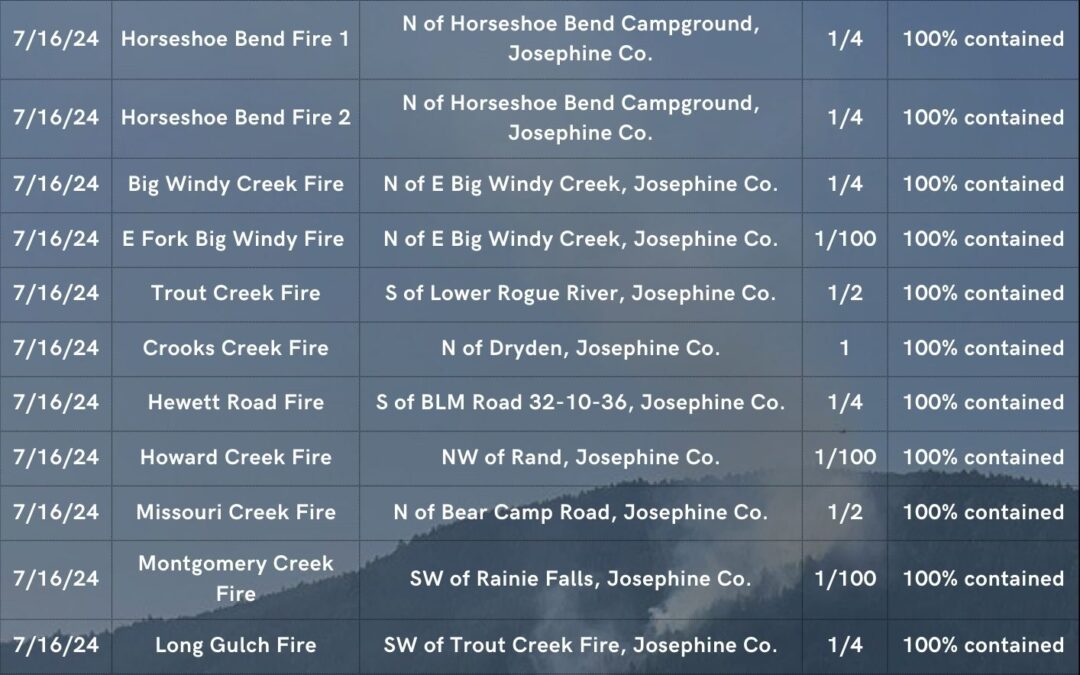
JACKSON and JOSEPHINE COUNTIES, Ore. (July 22, 2024) – Firefighters are completing the last portions of mop-up operations on two of the 17 lightning-caused fires that were found on Oregon Department of Forestry Southwest Oregon District and Bureau of Land Management (BLM) land within the last week, following numerous rounds of thunderstorms that moved through southern Oregon. Between July 15 and 22, five fires were reported on the ODF Medford Unit and 12 were reported on the Grants Pass Unit, all as a result of lightning. At this time, all are 100% contained but two, which are nearly mopped up. These fires affected ODF and BLM lands in Jackson and Josephine counties.
Thunderstorms first materialized on the evening of Monday, July 15, with a total of 66 lightning strikes recorded across the district. From this storm, firefighters responded to 13 fires, along with numerous other reports of smoke or fire that were not found to be present. Of these 13 fires, the largest, the Waters Gulch Fire, was stopped at just two acres. The next storm system arrived late Saturday night on July 20, with 18 recorded lightning strikes across both Jackson and Josephine Counties. Four fires were reported, two in each unit. This storm arrived with little to no rain, which allowed for more natural fire growth. Despite this, the largest fire from this group, the Sugarpine Gulch Fire, was caught at just over seven acres. Today, it is 100% lined and 100% mopped up.
These results are largely due to the aggressive initial attack that took place on each fire, as well as partnerships with local agencies, ranging from local structural departments to our federal partners at the BLM and U.S. Forest Service Rogue River-Siskiyou National Forest; the preparation of
all agencies and the readiness to respond to new fire starts largely contributed to the success on the ground.
Resources and equipment were also strategically used from the Salt Creek Fire, which was caught and lined at just over 4,100 acres and nearly entirely mopped up within the week and a half that the Oregon Department of Forestry Incident Management Team 1 was in command of it. As progress was quickly made on this incident, resources were available to respond to new fire starts and staff lightning-caused fires, even as the Salt Creek Fire transitioned to local control once more. Despite this pull on resources throughout its duration, the Salt Creek Fire is now 100% contained.
In the coming days, additional lightning-caused fires from these storms may surface. ODF Detection Center staff continues to monitor lightning strike areas and firefighters are keeping an eye on strike zones daily within their patrol areas. Reconnaissance flights will be conducted as needed. While these fires can’t be prevented, human-caused wildfires can be; the fire danger level in Jackson and Josephine Counties is extreme and the Industrial Fire Precaution Level is 3.
Help firefighters by following all current regulations to prevent human-caused fires. More information is available here:
• The ODF Southwest Oregon District: https://swofire.com/
• The BLM OR/WA Fire Management Page: https://www.blm.gov/orwafire
• Follow ODF and BLM on Facebook
• Follow ODF and BLM, RRSNF on Twitter
BLM-managed lands in the area of the Salt Creek Fire remain closed for safety. For more info go to: https://www.blm.gov/orwafire
# # #

July 22, 2024
Salem, Ore – Starting this past Wednesday, July 17, and into Sunday, July 21, Oregon experienced two separate lightning events that resulted in over 2,000 strikes across the state, which primarily affected Southern, Central and Eastern Oregon. With multiple crews engaged in initial attack on new fire starts and all of Oregon’s available incident management teams on assignment, now is the time for Oregonians to be prepared for wildfires and help prevent future ignitions.
Oregonians are urged to actively practice wildfire prevention, prepare their home and a go-bag for evacuation and know where to sign up for alerts.
How can people help prevent wildfires?
The Oregon Department of Forestry is urging the public to actively practice wildfire prevention as the state works to control over 20 large fires. Additional human-caused fires on the landscape will draw the firefighting efforts away from the lightning-caused fires and put extra strain on ground and aviation resources, which are already spread thin. YOU can help prevent wildfires by:
- Checking and following your local fire regulations. The majority of the state is either in high or extreme fire danger right now, meaning even the smallest of sparks could start the next large wildfire.
- Remember that debris burning is prohibited statewide.
- Return to check on your burn site if you burned earlier in the year.
- Make sure your car has been recently serviced to avoid faulty parts throwing sparks.
- Don’t drag tow chains.
- Avoid parking vehicles on tall, dry grass.
- Recreate responsibly. Where campfires are allowed, make sure your campfire is DEAD OUT before leaving it by drowning it with water, stirring it with a shovel and repeating that process until it is cold to the touch. If there is heat coming off it, there are still embers that could reignite.
How can I prepare my home to be resilient against fire?
The Oregon State Fire Marshal can help you create defensible space. Defensible space is the area around your home and property that’s maintained to prevent wildfire from spreading. Creating and maintaining defensible space is the best protection you can give your home against wildfire.
A few ideas to protect the first five feet around your home:
- Remove leaves, pine needles, and other debris from the roof, gutters, and on top of and underneath decks.
- Trim tall plants and bushes growing directly under eaves and make sure trees and plants have adequate space from your home and other vegetation.
- Remove dead and combustible plants and mulch; replace it with decorative rock or gravel.
- Cover exterior attic vents, soffit vents, and areas below decks and patios with 1/8″ metal wire mesh.
Be cautious with using power tools and other equipment that can throw sparks and don’t operate machinery in the heat of the day. Summer is a great time to plan defensible space projects to start working on in the fall when wildfire season is over.
How can I prepare myself in case I need to evacuate?
The Oregon Department of Emergency Management (OEM) urges everyone to prepare for wildfires and other emergencies by knowing evacuation levels, staying informed, having a plan, and having a go-kit ready.
Evacuation Levels
- Oregon follows a three-level evacuation notification system, each structured around safety threat level.
- Oregonians should become familiar with “Be Ready, Be Set, Go!” evacuation levels to make informed decisions when receiving evacuation notices.
- OEM urges people to evacuate whenever they feel unsafe, conditions can change rapidly; individuals should always make the best decision for their safety.
- Following an evacuation, people should not return to the area until public safety officials state it is safe.
Stay Informed
- Stay informed sign up to receive evacuation at, gov remember to update information if need be.
- Find the websites for your county emergency management, sheriff’s office, or tribal police and follow them on social media.
- Check your phone settings to ensure wireless emergency alerts are turned on.
Have a Plan
- Do you know what to do during an evacuation? This evacuation checklist explains what to do before, during, and after an evacuation.
- Establish a communication plan with a list of important contacts and a safe place for loved ones to meet if they are separated during an emergency.
- Identify multiple evacuation routes from home, work, or school and plan for transportation needs.
- People with disabilities should consider individual circumstances and specific needs when planning for evacuation, such as special equipment, transportation, and service animals.
- Have an evacuation plan for pets, make a pet evacuation kit in a tote bag or pet crate, and plan for transportation and sheltering of large animals such as horses and other livestock.
Make a Go-Kit
- Assemble an emergency kit of essential supplies that can be grabbed quickly.
- Pack an easy-to-carry backpack or bag for each household member with health and safety items such as food, water, medication, flashlights, phone chargers, clothing, and important documents. Visit American Red Cross to learn more.
Find more information and resources at Wildfire.Oregon.gov.
Recreate Responsibly
Oregon Parks and Recreation Department (OPRD) encourages visitors to know before they go when it comes to campfire restrictions. Due to the continued low humidity and risk of wildfires, OPRD banned campfires at all Oregon State Parks east of the Cascades as well as at parks in high-risk areas around the state until conditions improve. Most Oregon State Parks currently have a campfire ban. Please check park webpages or the wildfire feature story at stateparks.oregon.gov/ before your next visit. Thank you for helping to reduce the risk of wildfires.
July 22, 2024
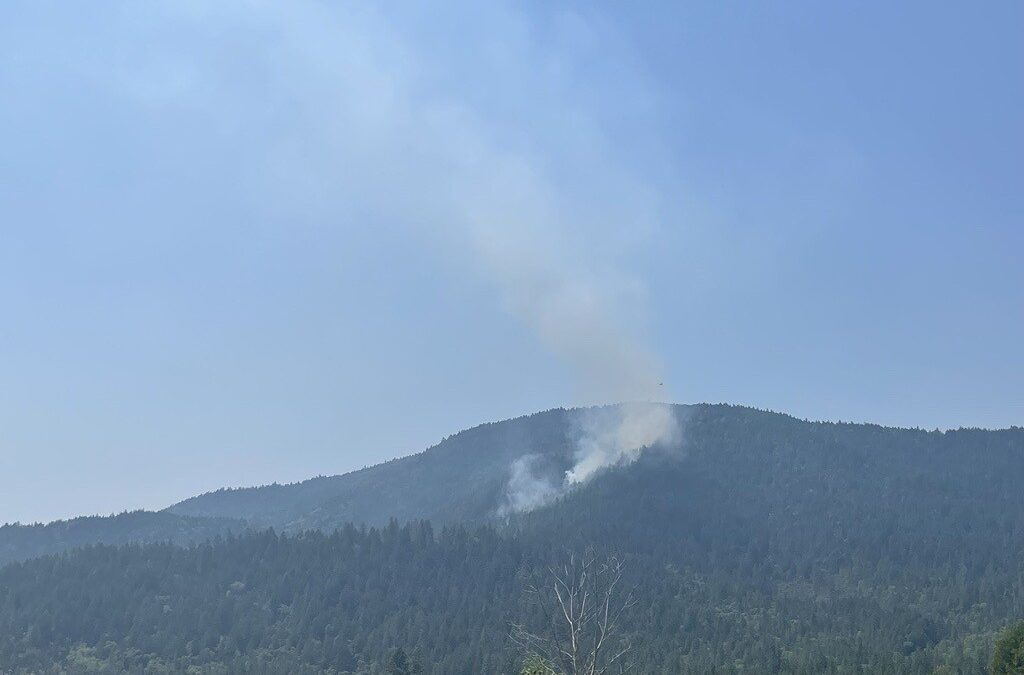
JACKSON AND JOSEPHINE COUNTIES, Ore. – Firefighters worked all day Sunday on four new lightning-caused fires across the Oregon Department of Forestry’s Southwest Oregon District. As of 6 p.m., all fires are 100 percent lined and in various stages of mop up.
The current fire status on ODF-protected lands in Jackson and Josephine Counties is as follows:
- The Sugarpine Gulch Fire, located northwest of Rogue River in Jackson County. This fire was the most challenging one, and the last to be 100% lined due to steep terrain and windy conditions. Currently 100 percent lined, 10% mopped up, and caught at just over seven acres. Numerous aircraft worked this incident all day, including one Type 3, two Type 2 and two Type 1 helicopters; some aircraft remain available and on standby but have not recently been needed. Engines, a bulldozer, crews, tree fallers and firefighters remain engaged on the ground and will continue to strengthen the line overnight and push forward on mop-up operations.
- The Eastside Road Fire, located along Upper Applegate Road and west of Buncom in Jackson County. This fire has been holding at an estimated two acres and is 100 percent lined and 20 percent mopped up. Operations are ongoing this afternoon and will continue overnight.
- The Canyon Creek Fire, located west of Highway 227 and northwest of Trail in Jackson County. This fire is now 100 percent lined and 30 percent mopped up. It was caught at just over six acres. Firefighters are engaging in mop-up operations that will continue overnight.
- The Old Baldy Fire, located in the hills between Wimer and Grants Pass in Josephine County. Firefighters caught this fire at an acre and a half, and have it 100 percent lined and 30 percent mopped up. Mop up operations are ongoing.
- The Sexton Fire, reported on the east side of Interstate 5, between Hugo and Sunny Valley in Josephine County, not found by firefighters after a thorough search.
A second recon flight was been conducted and no new fires have been found. Detection camera operators will continue to search lightning strike areas for any smoke or fires. Firefighters remain ready to respond to any new fire starts across the district.
The fire danger level in Jackson and Josephine Counties is extreme and the Industrial Fire Precaution Level is 3. Help firefighters by following all current regulations to prevent human-caused fires. For more information about the Oregon Department of Forestry’s fire season public and industrial restrictions, visit our website, www.swofire.com, our Facebook page @ODF Southwest Oregon District.
July 16, 2024
La Grande, OR—Fire managers are increasing the public use restrictions to Extreme (red), as well as implementing additional restrictions for industrial forest operations on lands protected by the Oregon Department of Forestry in Northeast Oregon. The additional restrictions will be in effect at 12:01 a.m. on July 16, 2024. The measurements fire managers reference to estimate seasonal fire severity indicate Extreme fire conditions across the region.
These restrictions are intended to decrease potential fire starts resulting from logging and other forest operations. Tinder-dry forest fuels increase the chance of a spark or ember igniting a wildland fire. The Industrial Restrictions apply to private, state, county, municipal, and tribal lands in seven counties: Union, Baker, Wallowa, Umatilla, and small portions of Malheur, Grant, and Morrow Counties. “It’s crucial to adhere to these restrictions as fuel conditions are changing rapidly with the extreme heat. We are seeing critically dry conditions in our light and flashy fuels,” said Logan McCrae La Grande Unit Forester.
REQUIRED SHUT DOWN: Except at landings, the use of mechanized harvesters with a high-speed saw, chainsaws, tracked felling or skidding equipment, slash busting equipment and cable yarding systems are prohibited between the hours of 12 p.m. and 8 p.m. local time.
The Public Use Restrictions (Extreme Fire Danger) include the following fire prevention measures:
- Open fires are prohibited, including campfires, charcoal fires, cooking fires, and warming fires.
- Portable cooking stoves using liquefied or bottled fuels are allowed.
- Propane fire pits are allowed if they are self-contained and 3 feet away from any flammable fuels with a maximum flame height of 2 feet.
- Non-industrial chainsaw use is prohibited.
- Electric Chainsaws are allowed all day.
- Mowing of dried and cured grass with power driven equipment is prohibited, except for the commercial culture and harvest of agricultural crops.
- Electric string trimmers are allowed all day.
- Any electric fence controller in use shall be: 1) Listed by a nationally recognized testing laboratory or be certified by the Department of Consumer and Business Services; and 2) Operated in compliance with manufacturer’s instructions.
- Possession of the following firefighting equipment is required for any vehicle/UTV/ATV traveling on unimproved roadways where flammable vegetation exists on the roadway; shovel or other firefighting tool, minimum of 1-gallon of water, or 2 ½ pound or larger fire extinguisher.
PROHIBITED
- All open debris burning including the use of burn barrels.
- Use of fireworks.
- Use of exploding targets.
- Cutting, grinding, and welding of metal.
- Use of tracer ammunition or any bullet with a pyrotechnic charge in its base.
- Smoking while traveling, except in vehicles on improved roads, in boats on the water, or at a cleared area free of flammable vegetation.
- Use of sky lanterns throughout the year in Oregon.
For further information, contact the Oregon Department of Forestry at these local offices:
| La Grande Unit |
(541) 963-3168 |
| Baker City Sub-Unit |
(541) 523-5831 |
| Wallowa Unit |
(541) 886-2881 |
| Pendleton Unit |
(541) 276-3491 |
Current fire restrictions for forestlands in Northeast Oregon can be found at www.bmidc.org or by calling the Northeast Oregon Fire Prevention line: (541) 975-3027.
http://bluemountainfireinfo.blogspot.com/ is your spot for current fire information in the Blue Mountains. Find us on Facebook at: https://www.facebook.com/oregondeptofforestryNEO/
Call Blue Mountain Interagency Dispatch at (541)963-7171 or dial 9-1-1 to report a fire.